

Explore the World From Your Couch
Author
Elisha Roodt
Date Published
A Glimpse into Revolutionary Immersive Storytelling
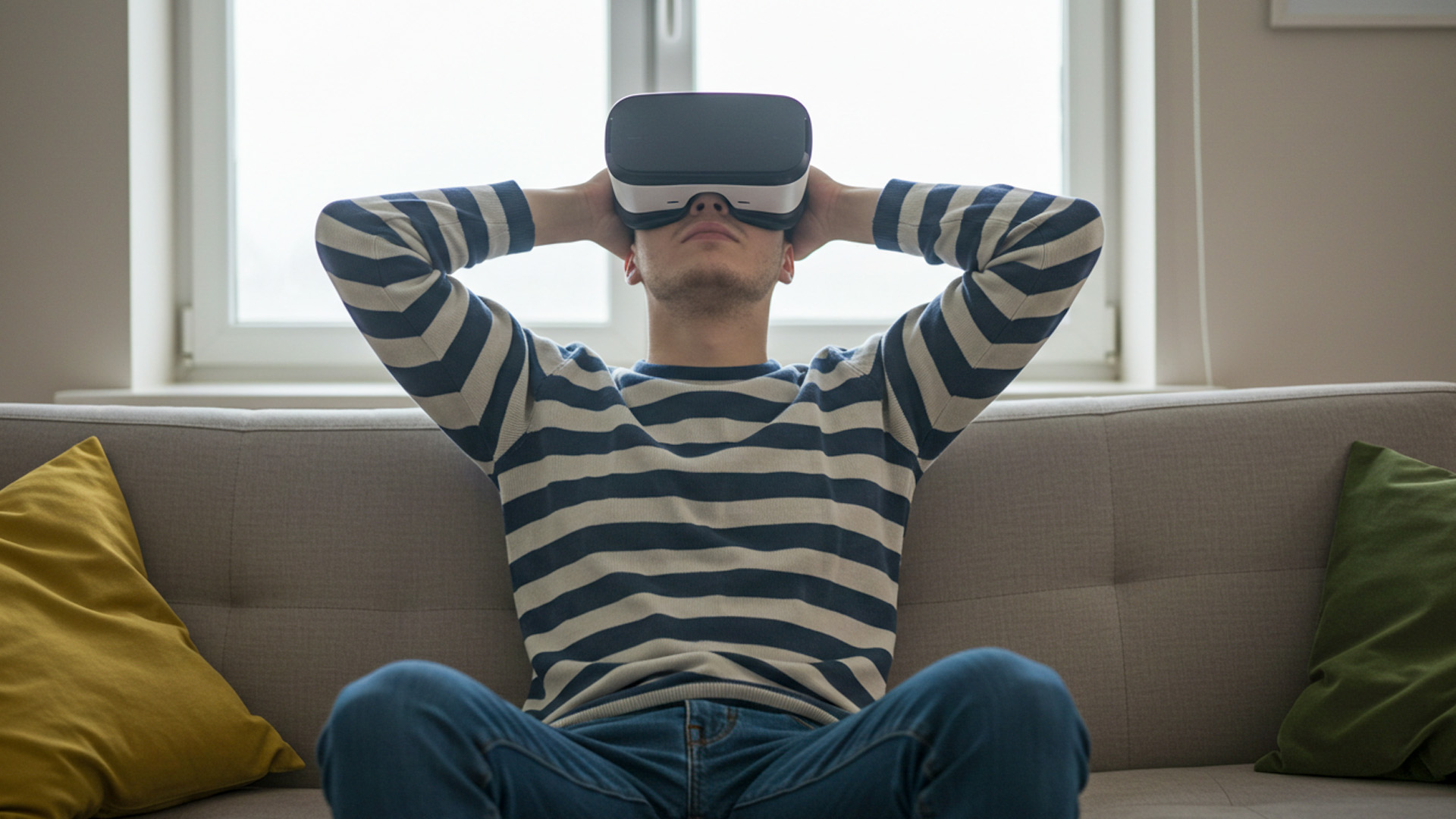
Imagine sipping your morning coffee in Johannesburg while wandering the bustling streets of Tokyo, or reclining in your lounge chair as you soar above the Andes. This is no longer poetic exaggeration—it is the tangible reality of immersive media. Virtual reality (VR), augmented experiences, and 360° narratives have dissolved geographic barriers, allowing anyone to traverse the globe without packing a suitcase. These technologies combine cinematic artistry, spatial computing, and interactivity to craft stories that feel lived rather than told. The essence of travel has shifted from mere physical displacement to perceptual enrichment, where digital landscapes ignite wonder, empathy, and curiosity as vividly as boarding a plane. This evolution transforms storytelling into a passport, empowering us to experience the world from the safety and intimacy of home.
Virtual Voyages in the Living Room
Simulated Presence Across Continents
When donning a VR headset, the living room transcends its mundane identity and morphs into a gateway. With photorealistic 3D renderings, you can stand amidst the aurora borealis or stroll down Parisian boulevards. This simulated presence blurs cognitive boundaries between “being there” and “imagining being there.” Neuroscientists liken it to lucid dreaming—the brain suspends disbelief because spatial cues, depth perception, and auditory immersion mimic real-world inputs. Such technology democratizes exploration by giving anyone the opportunity to savor experiences often locked behind financial or physical constraints. Suddenly, the Himalayas are not distant peaks but climbable paths in your own space.
Consider a retired teacher in São Paulo who always dreamed of visiting the Great Wall of China but never managed to. A VR tour allows her to wander along the ancient stones, appreciating the grandeur firsthand. While she may never step on the actual wall, the narrative of her life expands as though she had. This is not substitution but augmentation: experiences once impossible now integrate into personal memory. The living room becomes a wormhole collapsing distance and history into a single embodied moment.
The Architecture of Illusion
Creating such lifelike simulations requires meticulous design. Photogrammetry captures thousands of images from multiple angles, stitching them into intricate 3D models. Spatial audio layers environmental soundscapes: footsteps crunching on gravel, echoes in cathedrals, or seagulls shrieking above cliffs. The illusion thrives when sensory inputs coalesce, persuading the mind that “here” and “elsewhere” are indistinguishable. This architectural precision is akin to crafting stage sets, except the viewer occupies the stage itself. The sense of autonomy—turning your head, choosing where to walk—strengthens the fiction by making you an actor rather than a passive spectator.
Yet, illusion is not deception. It is revelation. Just as ancient cartographers drew maps not merely to chart territory but to inspire voyages, immersive designers construct digital geographies that coax curiosity. These architectures may never replicate reality in full fidelity, but they evoke it richly enough to spark imagination. Like gazing at a painting that moves the soul more deeply than the scene it depicts, VR environments amplify perception by reframing what “real” can mean.
Hypothetical Journeys as Personal Metaphors
Suppose a young entrepreneur, overwhelmed by the chaos of her startup, slips into a VR experience set in a tranquil Zen garden in Kyoto. The rustle of bamboo leaves and the ripple of water become metaphors for clarity. She returns to her work rejuvenated, not merely entertained. These journeys operate on two levels: geographic exploration and psychological introspection. Travel, after all, has always been about transformation, not just relocation. By condensing journeys into metaphors, immersive media preserves the ancient function of travel as a mirror reflecting who we are and who we wish to become.
Such hypotheticals highlight VR’s role as a catalyst for self-narration. Just as ancient myths encoded moral lessons through voyages across oceans, modern immersive journeys encode resilience, wonder, and empathy. The landscapes you traverse may be pixelated, but the emotions they awaken are authentic. In this sense, “travel without leaving home” is less a paradox and more an evolution of storytelling—one where our inner cartographies expand without crossing physical borders.

Cinematic Storytelling Through 360° Narratives
Expanding the Frame Beyond the Lens
Traditional cinema directs the viewer’s gaze with strict framing. But in 360° narratives, there is no “off-screen.” The world encircles the viewer like a sphere, demanding agency to decide where to look. This dissolution of the rectangular frame reshapes narrative grammar. Directors must choreograph attention using sound cues, lighting, or motion rather than cuts and zooms. The result is less like watching a film and more like inhabiting a dream, where every turn reveals new perspectives. This expansion complicates storytelling yet enriches immersion, making you not just an observer but a participant in the unfolding scene.
Imagine attending a Maasai ceremony captured in 360°. Instead of focusing only on the dancers, you might turn around to see elders observing quietly or children imitating the moves. Each angle offers a subplot, emphasizing that culture is multi-layered. Where traditional documentaries offer a slice, 360° storytelling offers the entire loaf, enabling viewers to carve their own narratives. Such expansiveness mirrors real travel, where serendipity and peripheral details often matter as much as the main attractions.
The Challenge of Narrative Cohesion
With limitless perspectives comes the challenge of coherence. If every direction contains action, how do creators ensure audiences still follow a meaningful arc? Story architects resolve this tension by embedding narrative “anchors”—recurring motifs, ambient soundscapes, or central characters that draw attention back to the main storyline. This resembles urban planning: a city may sprawl in many directions, but landmarks like plazas or towers orient navigation. Similarly, anchors in 360° films prevent disorientation while still honoring freedom of exploration.
For instance, a 360° narrative about space exploration might use the hum of a spacecraft engine as a constant auditory thread. No matter where viewers look—the Earth through a window, instruments on a panel, or astronauts floating nearby—that hum connects the fragments into a cohesive whole. Without such anchors, the experience risks fragmentation, leaving audiences dazzled but confused. Thus, narrative cohesion is less about restricting choice and more about orchestrating resonance across disparate views.
Metaphors of Multiplicity
360° storytelling is a metaphor for the multiplicity of truth. Just as two travelers visiting the same city return with different stories, two viewers of a 360° film may experience divergent yet equally valid narratives. This plurality aligns with the philosophy that reality itself is perspectival—shaped by where we stand and what we notice. By embodying this principle, immersive cinema teaches humility: no single angle exhausts the story. Every viewpoint reveals a fragment of the whole, reminding us that to understand the world, we must honor diverse perspectives.
Such multiplicity is more than artistic flourish; it cultivates empathy. When viewers recognize that their gaze constructs only part of the story, they become more open to others’ interpretations. This mirrors the act of travel, where encountering unfamiliar customs forces us to accept that our worldview is not absolute. In a polarized era, 360° narratives offer not just entertainment but civic pedagogy—teaching us that truth is spherical, not flat.

Augmented Realities Blending Home and Abroad
Layering Cultures onto Familiar Spaces
Augmented reality (AR) does not replace surroundings but overlays them with cultural fragments. Imagine scanning your kitchen table with a smartphone, only to see a holographic Taj Mahal rising from the surface. Such layering transforms ordinary spaces into portals. Unlike VR, which isolates users in fabricated worlds, AR fuses the foreign with the familiar. This interplay makes global heritage intimate. Instead of traveling to Egypt, you invite the pyramids into your living room, merging past and present, local and global, in one hybrid experience.
This blending is not trivial spectacle. It redefines how we learn and remember. A child who assembles an AR model of Machu Picchu on her desk internalizes geography and history differently than by reading textbooks. Knowledge becomes tactile and spatial, anchored in her everyday environment. Thus, AR democratizes cultural transmission, transforming the home into a classroom without walls. It reshapes “travel” into a dialogue between spaces—your own and those of distant civilizations.
Personalized Cultural Exchange
AR excels in customization. Unlike group tours where guides dictate the pace, AR allows individuals to control tempo and focus. One person may linger over an augmented sculpture’s details, while another skips directly to an animated reconstruction of its original temple. This flexibility mirrors the fluidity of modern digital culture, where playlists and feeds adapt to individual tastes. AR thus transforms cultural exchange from monolithic lecture into polyphonic dialogue, respecting the heterogeneity of curiosity.
Envision an elderly traveler revisiting Florence virtually. Instead of exhausting walks across cobblestones, she can summon AR frescoes onto her dining-room walls and examine them leisurely. Each detail is magnified, contextualized, and savored. The exchange is not diminished by its mediated form; in fact, it may be enhanced. Just as letters once carried intimacy across oceans, AR mediations carry cultural presence across time zones, proving that authentic connection need not require physical proximity.
Analogies of Home as a Museum
Think of your home as a museum, where AR curators rearrange exhibitions daily. The coffee table becomes a pedestal for African masks; the hallway morphs into a gallery of Renaissance paintings; the backyard hosts a holographic jazz concert from New Orleans. This analogy illustrates AR’s transformative potential. It does not demand new infrastructure, only imagination and digital overlays. Suddenly, “travel without leaving home” is not a compromise but a luxury—an ever-changing exhibition tailored to your curiosities.
In this sense, AR reframes domesticity as cosmopolitan. Just as the printing press once collapsed distances by delivering foreign stories into homes, AR collapses them visually and spatially. The boundary between traveler and host dissolves. You are both visitor and exhibitor, navigating a world that unfolds within your four walls. Home ceases to be static shelter and becomes a dynamic hub of global narratives, curated daily by digital artistry.

The Future of Nomadic Storytelling
Hybrid Journeys with AI Companions
The next horizon fuses VR, AR, and artificial intelligence into hybrid journeys. Imagine an AI travel companion who learns your preferences—guiding you to serene landscapes after stressful days or suggesting bustling markets when you crave stimulation. This companion becomes a digital cartographer of your psyche, charting itineraries not just across geographies but across moods. Such symbiosis marks the evolution from static content to responsive experience, where “travel” adapts as fluidly as conversation with a friend.
These AI companions embody more than convenience; they evoke the role of mythic guides in epic journeys. Just as Virgil accompanied Dante through the Divine Comedy, tomorrow’s travelers may be escorted by algorithms. The narrative of travel thus becomes collaborative: the user provides intent, the AI provides pathways. This partnership reframes technology not as cold machinery but as a co-narrator whispering directions on a boundless map of experiences.
Sustainability of Digital Nomadism
Amid climate anxieties, digital travel offers ecological reprieve. Jet fuel emissions shrink when wanderlust finds satisfaction in pixels rather than airplanes. While no simulation can replace the tactile sensation of sand between toes, many journeys motivated by curiosity rather than necessity can migrate to immersive media. In this sense, “travel without leaving home” becomes a strategy for planetary stewardship. The Earth benefits when we channel some of our exploratory impulses into digital realms rather than physical itineraries.
This is not an argument against physical travel but a rebalancing of scales. Just as teleconferencing reduced unnecessary business flights, immersive storytelling may reduce casual tourism’s footprint. It encourages us to reserve physical journeys for transformative pilgrimages while satisfying everyday curiosities through virtual detours. Thus, digital nomadism emerges not as escapism but as sustainability—a way to explore responsibly while preserving fragile ecosystems for future generations.
The Metaphor of Infinite Windows
Think of immersive technologies as an endless array of windows opening from your home into the world. Each window reveals a different landscape: the Sahara’s dunes, Venice’s canals, Antarctica’s glaciers. Unlike physical windows, these are not limited by architecture. They can multiply infinitely, rearrange at will, and adapt to your curiosity. The metaphor underscores the abundance of possibilities: the world is not shrinking but multiplying through layers of accessible narratives.
Infinite windows also symbolize a philosophical shift. Where once home meant isolation from the world, now it means connection to it. The walls no longer separate but project. Through these windows, you may never exhaust the vistas available. Travel without leaving home, therefore, is not confinement but expansion—an expansion of perception, empathy, and possibility. The journey continues endlessly, framed not by geography but by imagination.

The Future Of Nomadic Storytelling