

Hyper-Realistic VR: The Future of Immersive Gaming with Micro-OLED Displays and Precision Depth Tracking
Author
Elisha Roodt
Date Published
Why Hyper-Realistic VR Is Suddenly Plausible
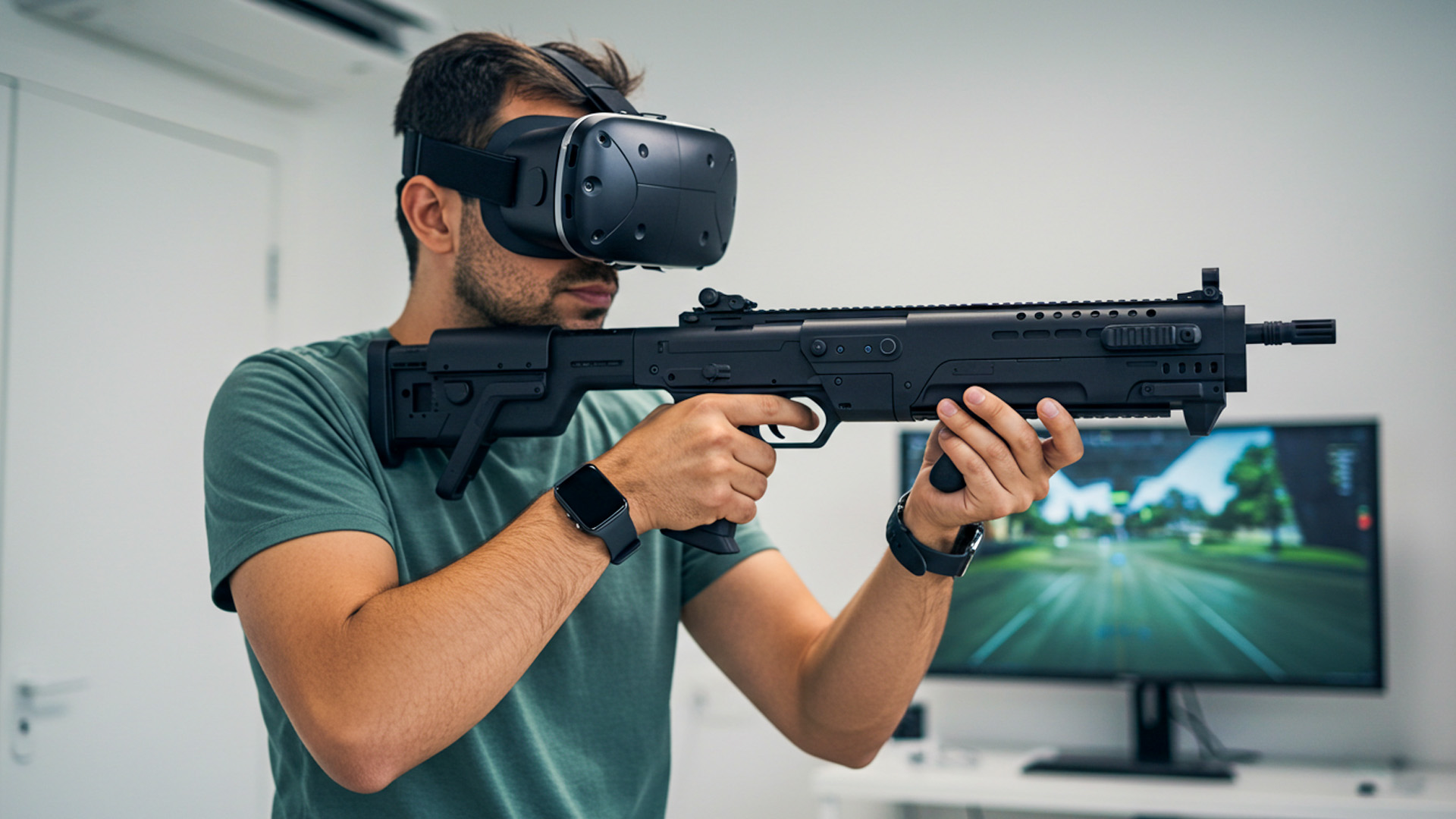
Imagine stepping into a game world where your eyes forget the headset and your body forgets the room. That uncanny threshold—where simulation becomes sensation—is now within reach thanks to micro-OLED displays, advanced depth tracking, and rendering pipelines tuned to human perception. The promise is not merely sharper pixels; it’s believable presence built on optics, geometry, and cognition. In the pages below, we’ll trace how display engineering, tracking mathematics, and sensor-driven rendering are converging to deliver lifelike virtual worlds that respond to your gaze, your hands, and your expectations with startling immediacy.
The Display Leap: Micro-OLED, Pancake Optics, and Human-Eye Fidelity
Micro-OLED Pixel Density and Persistence
Micro-OLED panels bring a cocktail of qualities that finally make head-mounted displays feel less like gadgets and more like glazing for alternate realities. Their emissive architecture delivers per-pixel control over luminance, enabling deep blacks, high contrast, and fine-grained temporal behavior that LCDs struggle to match. Critically, micro-OLED modules enable unusually high pixel density on tiny substrates, which drives angular resolution up and the dreaded screen-door effect down. When motion enters the picture, low-persistence driving minimizes smear, preserving detail through fast head rotations. In practice, this translates to sharper text, crisp specular highlights, and silhouettes that resist shimmering when you glance, pivot, or sprint across digital terrain.
Resolution only counts if optics can deliver it to the retina without mangling modulation. Here, compact displays free lens designers to pursue shorter optical paths with aggressive folding, keeping mass near the face and reducing moments that fatigue the neck. Meanwhile, micro-OLED’s high fill factor improves verisimilitude in dark scenes where subtle gradients define form. Artists notice they can author thinner film-grain, finer normal maps, and tighter depth-of-field cues without collapsing into noise. In gameplay, legibility gains are tangible: UI elements stay readable, aliasing is less distracting at distance, and volumetric effects—fog, god rays, embers—resolve with a cinematic smoothness that makes the world feel hand-crafted rather than algorithmically assembled.
Pancake Lenses, MTF, and Chromatic Discipline
Pancake optics behave like tiny periscopes, bouncing light through polarizers to compress path length and flatten the stack. Beyond ergonomics, they reshape image quality budgets. By raising modulation transfer function (MTF) across a wider field, pancakes preserve high-frequency contrast that would otherwise be wasted on lens blur. Another prize: less chromatic aberration in the periphery, so colored fringes around text and edges diminish significantly. With fewer optical compromises to correct in software, rendering pipelines can devote cycles to lighting, shadows, and physics rather than post-warping every frame. The result isn’t just thinner headsets; it’s cleaner imagery that stays coherent as you scan the scene.
Consider a stealth mission where you crouch behind slatted wooden shutters, peeking at patrols through millimeter gaps. On legacy lenses, moiré and axial color shift could betray the art direction, turning tension into visual noise. Pancake optics stabilize those high-frequency patterns, letting the renderer carry delicate geometry without shimmering. Peripheral clarity matters too: when a guard moves at the edge of your vision, the signal survives lens transport, priming saccadic motion detection that feels eerily real. This optical discipline reduces the cognitive friction of “VR-ness,” letting the narrative dominate. You remember the chase and the rain, not the headset’s idiosyncrasies.
HDR, Color Volume, and Retinal Contrast
Brightness in VR is more than flash; it’s a semantic channel. High dynamic range (HDR) paired with precise local control helps convey material identities—polished obsidian, waxy skin, metallic flakes—through specular energy and micro-contrast. Micro-OLED’s deep blacks scaffold these highlights with convincing shadow structure, mapping the world’s luminance in a way the visual cortex accepts without negotiation. Color volume matters too: richer primaries and stable midtones keep foliage from collapsing into mush and prevent skin from sliding into plasticity. When your brain trusts the light, your body trusts the space. That trust is presence, and presence turns mechanics into moments.
Imagine emerging from a dim tunnel into a snowy courtyard at dusk. HDR ensures crystalline sparkle without blowing out detail, allowing particle systems to sparkle while keeping texture fidelity on exposed stone. Retinal contrast at low luminance becomes crucial: think candlelit maps, moonlit puddles, or ink-black corridors punctured by electronic LEDs. If the display can stage these micro-contrasts without banding or flicker, designers can communicate distance, threat, and temperature nonverbally. Subtlety accelerates comprehension: you sense the slippery patch before you step, you feel the hush before an ambush. High-integrity luminance is not garnish; it’s gameplay grammar.

Depth, Presence, and the Geometry of Tracking
Sub-millimeter 6DoF: From SLAM to Neural-SLAM
Presence depends on geometry updating at the speed of intent. Inside-out tracking leverages simultaneous localization and mapping (SLAM) to estimate head pose from camera streams, fusing inertial measurements to bridge between frames. As models learn scene priors—edges, planes, and texture recurrences—pose solves become more robust under motion and occlusion. Neural-SLAM goes further, compressing spatial structure into latent features that survive poor lighting and repetitive textures. The practical outcome for players is simple: jitter fades, “floaty” head motion disappears, and precise 6DoF confidence extends into the corners of your room. You can lean, sidestep, and pivot without the system second-guessing you.
On the micro scale, improved depth estimation shrinks the error bars that once made tabletop interactions feel like approximations. Consider lining up a sniper scope: sub-millimeter coherence ensures that micro-adjustments of your cheek and shoulder propagate into equally precise parallax changes. On the macro scale, reliable drift control keeps large environments consistent over long sessions, so revisiting locations feels anchored rather than subtly skewed. Developers can place puzzle affordances at tight tolerances, knowing tracking won’t blur intent. What you mean to do—and what the world understands—finally converge, yielding mechanics that reward finesse instead of forgiveness.
Occlusion as Narrative: Hands, Props, and Environmental Anchors
Realistic occlusion is the difference between “cardboard theater” and embodied presence. When your hand passes in front of your face, the rendering pipeline must clip geometry with convincing temporal stability. Advanced depth sensors and monocular depth networks predict both static structure and moving limbs, allowing dynamic occlusion that holds under fast motion. In mixed reality games, accurate occlusion lets virtual fog creep behind your coffee mug and lets a digital cat hide under your real table. These micro-events carry narrative meaning. The world obeys coherent visibility rules, so you instinctively believe what you see—even when it’s impossible.
Designers can exploit occlusion to choreograph tension. Picture a cooperative heist: you slide a physical notebook over a glowing virtual blueprint; the light breaks realistically, masking a security code that only your partner can see from another angle. Props become verbs. Environmental anchors—doorframes, monitors, shelves—act as theatrical flats that virtual actors can lean against, pencil behind the ear, cigar ember haloed by bloom. Achieving this requires not just depth maps, but temporal coherency across frames so that popping and z-fighting don’t betray the trick. Done right, occlusion becomes a silent storyteller, moving attention with the elegance of a stagehand.
Latency, Prediction, and Motion-to-Photon Alchemy
Every credible VR system wages war on latency: the interval between intention and illumination. Prediction models extrapolate head pose forward, asynchronous timewarp corrects after the fact, and reprojection strategies keep images glued to reality even when the GPU stumbles. High-rate IMUs inform short-term motion guesses while camera updates rein in drift; the pipeline juggles these estimates to deliver tight motion-to-photon timing. It’s alchemy built on calculus. Trim those milliseconds and your vestibulo-ocular reflex says, “Yes, this is real,” reducing cybersickness and preserving spatial memory. The win is qualitative: the world “sticks” during rapid saccades and sudden pivots.
In gameplay terms, low latency translates to trust. When you parry a sword strike, your timing comes from the rhythm of animation and the inertia in your wrist, not from second-guessing the display. Good prediction also lets developers push bolder mechanics—wall-runs, grapples, or zero-g maneuvers—because control remains intelligible at high speeds. Meanwhile, eye tracking provides per-saccade insight, so renderers can harden the future gaze point before the eyeball arrives. The system is continually betting on your next gesture and hedging with corrective math. When the bet is good, you feel powerful, not piloted.

Rendering Like Reality: Eye-Tracked Foveation, Path Tracing, and Neural Fields
Foveated Pipelines and Saccade-Aware Rendering
Human vision is aggressively nonuniform: acuity peaks in the fovea and falls off quickly. Eye-tracked foveation exploits this gradient, allocating shading precision to where you’re actually looking and relaxing it in the periphery. With micro-OLED resolving fine detail, the budget reclaimed off-axis funds higher quality materials, denser geometry, or richer post effects in the gaze cone. The trick is anticipating saccades, those ballistic eye jumps that happen several times per second. Predictive masks and ultra-fast gaze sampling keep the high-res “hotspot” a step ahead, so you never catch the renderer moving the spotlight.
Players experience this as effortlessness. Text stays pin-sharp when you scan HUD elements, while distant terrain remains credible without wasting arithmetic on invisible details. Developers can treat foveation as a design tool, sculpting attention with sharpness, chroma, and motion energy rather than heavy-handed vignette. Combined with variable rate shading, the pipeline becomes elastic, stretching compute toward drama and away from dead zones. The metaphor is stage lighting: a crisp key light for what matters now, ambient wash for the rest. Attention is a currency; foveation ensures it’s spent where it buys the most presence per millisecond.
Real-Time Global Illumination and Ray Queries
Reality cheats with photons that bounce, diffract, and seep through translucent media. Games emulate this through a collage of techniques, but hardware-accelerated ray queries and screen-space caches are turning that collage into something closer to physics. Real-time global illumination stabilizes color bleeding, softens penumbras, and prevents light probes from lying when doors open or fires spread. In VR, these cues sell shape and distance in ways even high resolution cannot. When a torch gutter flickers, your brain tracks the moving shadows and infers volume. When moonlight skims a tile floor, the specular lobe whispers the angle of the surface.
Developers wield a hybrid palette: screen-space reflections for speed, ray-traced hits for veracity, and probe grids for continuity. The goal is not benchmark-chasing shininess but coherent radiance under motion. With eye tracking, the renderer can invest more rays in the foveal zone, firming up caustics on a blade or the ripple lines across a puddle just as you inspect them. Because VR doubles the viewpoint, temporal techniques must be carefully phase-aligned to avoid stereo inconsistencies, but the payoff is immense. When lighting obeys intuition, you explore faster, read surfaces sooner, and accept the world’s physics as givens rather than guesses.
Neural Radiance Fields and Generative Assets
Neural radiance fields (NeRFs) and their real-time cousins bring photogrammetric richness to runtime. Instead of modeling every vertex, these systems learn how light radiates through captured scenes, enabling reconstructions that carry the messy texture of reality—wires, grime, imperfect paint—without hand-authoring it all. For games, NeRF-derived assets can bootstrap levels with credible clutter and then hand off to conventional meshes for interaction. Pair this with procedural generation driven by foundation models and you’re looking at worlds that feel hand-touched because they were trained on the residue of the real. The uncanny valley narrows not through perfection, but through believable imperfection.
Performance had been the anchor, but hardware and clever caching are lifting it. Tiled inference, sparse voxel structures, and distillation into textured blocks let engines stream neural content where it counts. Eye tracking again acts as a governor, prioritizing inference near gaze and downshifting elsewhere. Designers gain a new language: evocative spaces assembled from micro-stories in the data—scratched brass on door handles, uneven plaster at ankle height, fingerprints on glass. The cost is not accuracy for its own sake; it’s density of cues your brain interprets effortlessly. With more authentic micro-signals, the macro illusion locks into place.

Embodied Interaction: Haptics, Spatial Audio, and Cognitive Ergonomics
Haptic Stratigraphy: From Micro-Vibrotactile to Force Feedback
Touch is the quiet co-author of presence. Layered haptics—micro-vibrotactile buzz, mid-band rumble, and low-frequency thump—work like percussion, encoding material identity and event magnitude. A micro-motor can sketch the texture of linen; a voice-coil can deliver the body of a shotgun report; a brake can resist your wrist as you torque a valve. In concert with physics and audio, haptics binds intent to effect. Designers should think in strata: surface grain, structural resonance, and inertial resistance. When these layers align with visuals, your brain stops supervising and starts inhabiting. The controller becomes a conduit rather than a reminder.
Force feedback, even in small doses, unlocks nuanced verbs. A subtle detent at the end of a bow draw teaches you optimal power without UI. A compliant spring under a lockpick communicates the shear line’s flirtation. Advanced gloves and exoskeletons promise richer force envelopes, but clever constraints can do wonders today: magnetic clutches, asymmetric vibration, and pulse-width tricks simulate hardness and weight changes surprisingly well. The narrative payoff is agency. When the world pushes back—lightly, believably—you read its rules through your skin, and mechanics that might have felt arbitrary transform into learned skills with muscle memory attached.
Psychoacoustics in 3D: HRTFs, Early Reflections, and LFE
Spatial audio completes the illusion by colonizing your periphery. Head-related transfer functions (HRTFs) model how your torso, head, and pinnae filter sound, letting engines place whispers above you and footsteps behind with surgical precision. Early reflections paint the room: a tight slap off concrete, a velvety smear in a theater, the hollow bloom of a stairwell. Low-frequency energy (LFE) carries weight; when a dragon lands, sub-bass tells your viscera before your eyes catch the dust. These cues sharpen orientation and reduce visual over-exertion, because the brain can triangulate threat and distance without fixating on pixels.
In practice, psychoacoustics enables elegant design shortcuts. A thinned footstep EQ means “far”; a ducked high end means “around the corner”; a flanged tail hints at “metal corridor.” With eye tracking, engines know when you’re not looking and can subtly amp cues to coax attention without resorting to UI arrows. Accurate occlusion, diffraction, and material-specific absorption keep the sonic world consistent with visuals, cementing trust. When a shop door closes, the conversation outside should get boxy and muted; when a cave opens, consonants should sparkle with flutter echo. Get these right, and players navigate by instinct rather than instruction.
Comfort, UX Heuristics, and Presence Budgeting
Hyper-realism must serve comfort. Presence is a budget spendable on resolution, framerate, latency, and locomotive freedom; if you overspend on one axis, the body will charge interest elsewhere. Smart UX harnesses biological rhythms: blink-aware transitions during saccades, gentle acceleration ramps to respect vestibular expectations, vignette modulation that activates only when angular velocity spikes. Even micro-interactions matter—grab poses that respect neutral wrist angles, snap-turn increments that align with scene symmetries, reticles that “breathe” instead of jitter. When design cooperates with physiology, users stay longer, learn faster, and carry memories from sessions like they were places visited, not software used.
Consider a climactic boss fight. The visual temptation is maximal spectacle, but the presence-savvy approach is orchestration. Reduce peripheral flicker during dodge phases to minimize visual vestibular conflict; allocate foveated detail to telegraphed attacks so timing feels fair; use audio occlusion to hint at off-screen threats without forcing frantic head movements. Celebrate success with haptic swell rather than flashbang brightness. These aren’t concessions; they’re craft. Hyper-realistic VR isn’t about pushing every dial to eleven, but about tuning a symphony where optics, acoustics, and mechanics harmonize around human limits. The showstopper is not graphics alone; it’s grace under interaction.

Embodied Interaction